
The duodenum is a small but critically important part of your digestive system and when something goes wrong here, the symptoms can range from mild discomfort to a life-threatening surgical emergency. This guide brings together everything you need to know about the most common (and some rare but important) duodenal diseases, written in plain language and backed by current clinical evidence.
If you’ve been searching for answers about stomach pain, ulcers, unexplained weight loss, or a recent diagnosis involving your duodenum, this page is designed to be your starting point. Each section links to a more detailed guide where relevant.
What Is the Duodenum and What Does It Do?
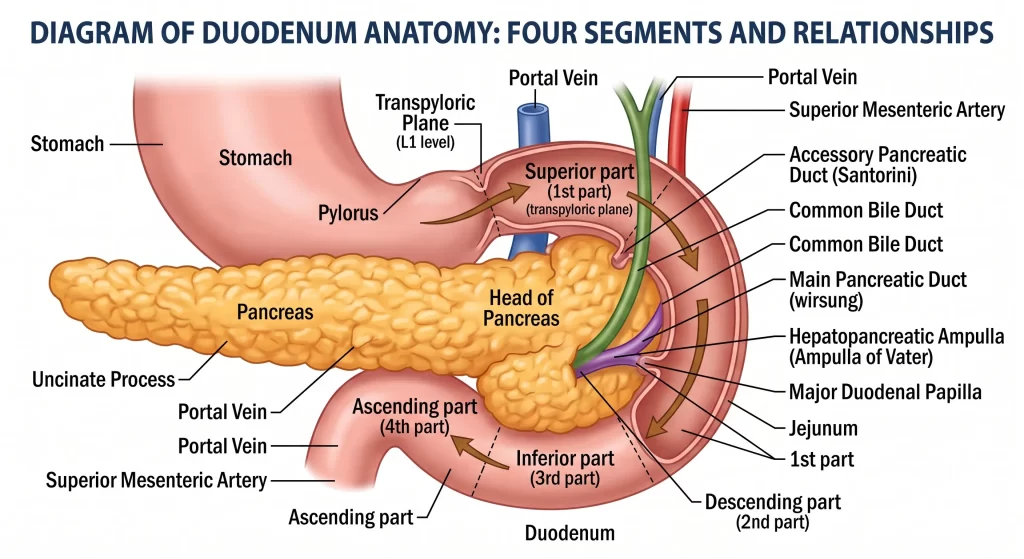
The duodenum is the first and shortest part of the small intestine, forming a C-shaped curve roughly 25–30 cm long that connects the stomach to the rest of the intestines. It is divided into four segments, each sitting close to major organs like the liver, pancreas, and gallbladder.
Despite its small size, the duodenum does heavy lifting: it neutralizes acidic stomach contents, mixes in bile and pancreatic enzymes, and kicks off the absorption of calcium, iron, fats, and proteins. This central role is exactly why duodenal problems can affect digestion so broadly — and why they need timely attention.
Dr. Nirav Vakani specializes in the diagnosis and surgical treatment of duodenal conditions — see his duodenum specialist in Ahmedabad for consultation details.
Who Gets Duodenal Diseases? (Age-Wise Patterns)
Clinical data tracking thousands of diagnosed duodenal disease cases shows a clear age pattern. Younger and adult patients are far more likely to develop duodenal ulcers and duodenitis, largely driven by H. pylori infection and painkiller (NSAID) use. Older adults, on the other hand, see a sharp rise in structural problems like duodenal diverticula and tumors diverticula rates jump from around 3% in adults to nearly 14% in the elderly, and tumor rates roughly double.
This matters practically: a 30-year-old with burning stomach pain is usually dealing with an ulcer, while a 70-year-old with new digestive symptoms needs to be screened more carefully for structural or neoplastic causes.
Duodenal Ulcer (Peptic Ulcer Disease)
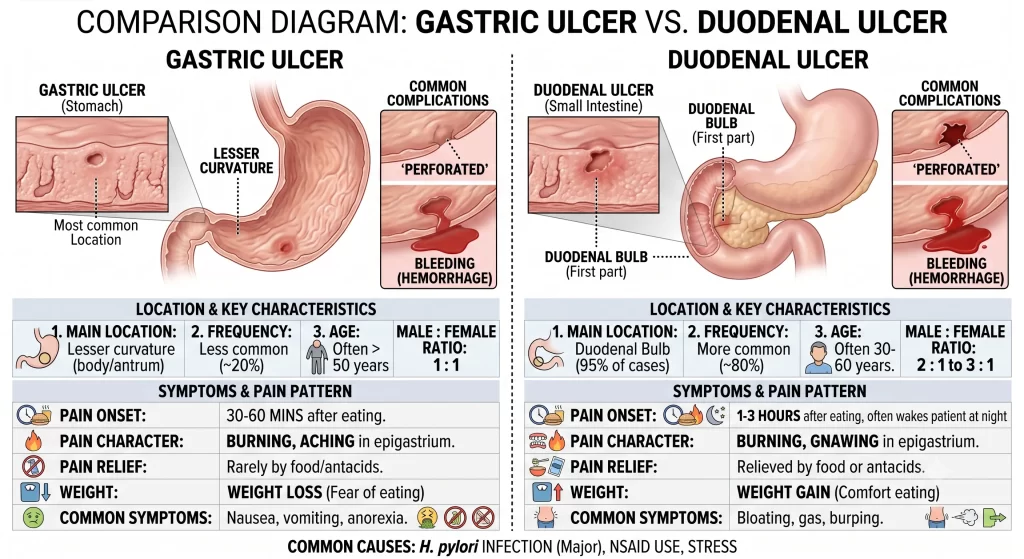
A duodenal ulcer is an open sore that forms in the lining of the duodenum, most often in its first segment (the duodenal bulb). It develops when stomach acid overwhelms the gut’s natural protective defenses.
Causes
- H. pylori infection — this bacterium increases acid production and weakens the mucosal lining
- NSAID use (ibuprofen, diclofenac, aspirin) — these drugs block the protective prostaglandins that shield the gut lining
Symptoms
Classic duodenal ulcer pain is a burning sensation in the upper abdomen that appears 2–3 hours after eating or wakes you up at night. Unlike stomach ulcers, duodenal ulcer pain typically improves with food or antacids — a useful clue when self-assessing your symptoms (though not a substitute for proper diagnosis).
Treatment
Most duodenal ulcers heal with acid-suppressing medication (proton pump inhibitors) and, if present, H. pylori eradication therapy (a course of antibiotics). Surgery is reserved for complications most importantly, perforation, covered below.
Learn more about surgical options for duodenal conditions on our duodenum surgery page.
Duodenitis (Inflammation of the Duodenum)
Duodenitis is inflammation of the duodenal lining, often caused by the same triggers as ulcer disease H. pylori and NSAIDs — but also by excess alcohol, smoking, or chronic stress. Symptoms overlap significantly with ulcer disease: upper abdominal pain, nausea, bloating, and early fullness.
Diagnosis usually requires an upper endoscopy with biopsy, since duodenitis can look similar to early ulcer disease or even celiac disease on the surface. Treatment centers on removing the trigger (H. pylori treatment, stopping NSAIDs) plus short-term acid suppression.
Perforated Duodenal Ulcer A Surgical Emergency
Warning Signs Seek Emergency Care Immediately
- Sudden, severe, board-like abdominal pain
- Pain that spreads to the shoulder
- Rigid, tender abdomen
- Fever, rapid heartbeat, or signs of shock
How It’s Treated
Small, stable, “contained” perforations may occasionally be managed non-surgically under close hospital monitoring. However, most free perforations require emergency surgery typically a simple repair reinforced with a patch of omentum (the fatty tissue that drapes over the abdominal organs). Larger or more complex perforations may need more advanced reconstructive surgery to restore normal bowel continuity.
Perforation can also occasionally occur as a rare complication of procedures like ERCP (endoscopic bile duct procedures) or gallbladder surgery, which is why choosing an experienced GI surgical team matters for any upper abdominal procedure
For what to expect after any duodenal operation, see our GI surgery safety and recovery guide.
Duodenal Cancer and Tumors
This is for informational purposes only. For medical advice or diagnosis, consult a professional.
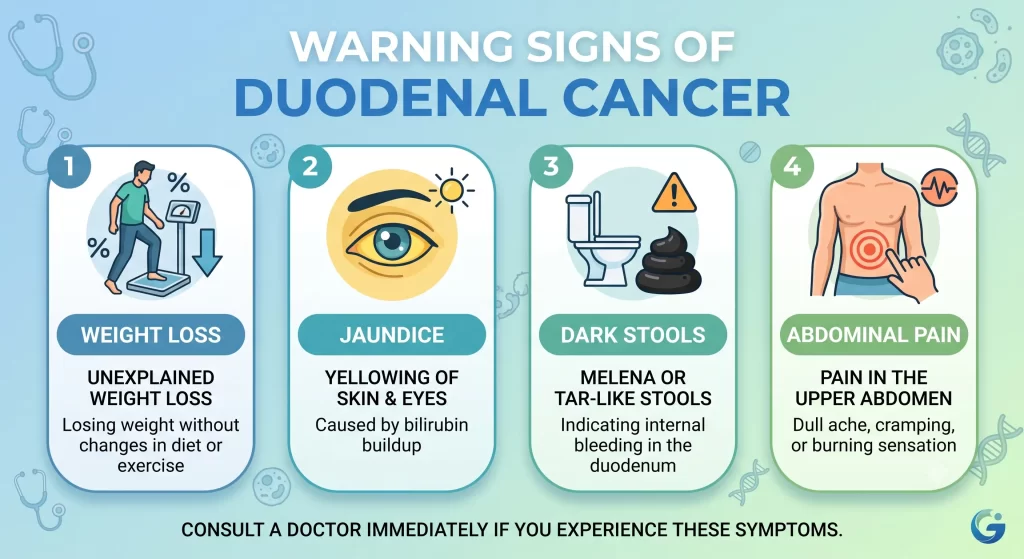
Duodenal cancer is uncommon but important to catch early, since the duodenum’s location next to major blood vessels and the pancreas makes surgery more complex the later it’s diagnosed.
Duodenal Adenocarcinoma
This is the most common type of duodenal cancer. Warning signs include unexplained weight loss, dark or tarry stools, persistent nausea, jaundice (yellowing of skin/eyes if the tumor is near the bile duct opening), and abdominal pain. Treatment for localized disease is surgical ranging from local removal to a Whipple procedure (pancreaticoduodenectomy) for tumors closer to the pancreas and bile duct.
Duodenal GIST (Gastrointestinal Stromal Tumor)
GISTs are rare tumors that grow from the muscle wall of the duodenum rather than its lining. They often present with gastrointestinal bleeding (dark stools or vomiting blood) because the overlying mucosa ulcerates. Because they can look identical to pancreatic tumors on scans, accurate diagnosis (often via endoscopic ultrasound biopsy) is essential before planning surgery. Complete surgical removal with clear margins is the standard treatment, sometimes followed by targeted drug therapy for higher-risk tumors.
Celiac Disease and the Duodenum
Celiac disease is an immune reaction to gluten that specifically damages the duodenal lining, flattening the tiny finger-like projections (villi) that absorb nutrients. This leads to chronic diarrhea, unexplained weight loss, iron-deficiency anemia, and fatigue.
Diagnosis starts with a blood test (ttg-iga antibody) while still eating gluten, followed by confirmation via duodenal biopsy during endoscopy doctors typically take at least six samples from different parts of the duodenum, since the damage can be patchy. The only proven treatment is a strict, lifelong gluten-free diet. A follow-up biopsy around two years later is often recommended to confirm the gut lining has healed.
Superior Mesenteric Artery (SMA) Syndrome A Rare Cause of Duodenal Obstruction
SMA syndrome (also called Wilkie’s syndrome) is an uncommon but important condition where the third part of the duodenum gets physically compressed between two major blood vessels — the aorta and the superior mesenteric artery. This usually happens after rapid, significant weight loss (from eating disorders, severe illness, or major surgery), which shrinks the protective fat cushion between these vessels.
Patients typically describe fear of eating, early fullness, bloating, and bile-stained vomiting, with symptoms often easing when lying on the left side or in a knee-to-chest position. Initial treatment focuses on nutritional rehabilitation to rebuild the fat cushion; if this fails, surgery to bypass the compressed segment (duodenojejunostomy) is highly effective and is usually done laparoscopically
This condition shares some overlap with mechanical bowel blockages more broadly see our guide on bowel obstruction surgery, causes and recovery for related information.
Familial Adenomatous Polyposis (FAP) and Duodenal Polyps
FAP is an inherited condition that causes hundreds of polyps to form in the colon and, importantly, the duodenum as well. After the colon is surgically removed (standard practice by around age 20 in FAP patients), duodenal polyps become the next major long-term risk, with a small but real chance of progressing to cancer over time.
Doctors track this risk using a scoring system (the Spigelman classification) based on the number, size, and microscopic appearance of the polyps found on endoscopy. Based on the score, surveillance may range from repeat endoscopy every few years to surgical removal of high-risk polyps or, in advanced cases, more extensive duodenal surgery.
Other Rare Duodenal Conditions Worth Knowing About
- Duodenal Crohn’s disease : a rare form of Crohn’s disease that causes narrowing (strictures) and, occasionally, fistulas in the duodenum, usually in patients who already have Crohn’s elsewhere in the gut.
- Zollinger-Ellison syndrome : a rare hormone-secreting tumor (gastrinoma) that causes severe, treatment-resistant ulcers by driving extreme acid production.
- Lemmel’s syndrome : a small pouch (diverticulum) near the bile duct opening that can compress the bile duct and cause jaundice, without any gallstones being present.
These are uncommon, but worth mentioning to your doctor if standard ulcer treatment isn’t working as expected, or if imaging shows an unexplained diverticulum near the bile duct
When Should You See a GI/HPB Surgeon?
Book a consultation promptly if you notice:
- Persistent upper abdominal pain lasting more than 2 weeks despite antacids
- Vomiting blood or passing black, tarry stools
- Unexplained weight loss
- Jaundice (yellowing of eyes or skin)
- Sudden, severe abdominal pain (go to emergency care immediately)
Not every duodenal condition needs surgery many respond well to medication alone. But an accurate, timely diagnosis is what determines that outcome, which is why persistent symptoms deserve a proper evaluation rather than prolonged self-treatment.
Nutrition After Duodenal Treatment
Whatever the underlying diagnosis, diet plays a supporting role in recovery particularly after any duodenal surgery. See our detailed diet guide after duodenal surgery for practical, stage-by-stage nutrition advic
Medical References:
1. Anatomy, Abdomen and Pelvis: Duodenum StatPearls, National Center for Biotechnology Information (NIH)
2. Zollinger-Ellison Syndrome National Institute of Diabetes and Digestive and Kidney Diseases (NIDDK), U.S. Department of Health & Human Services